
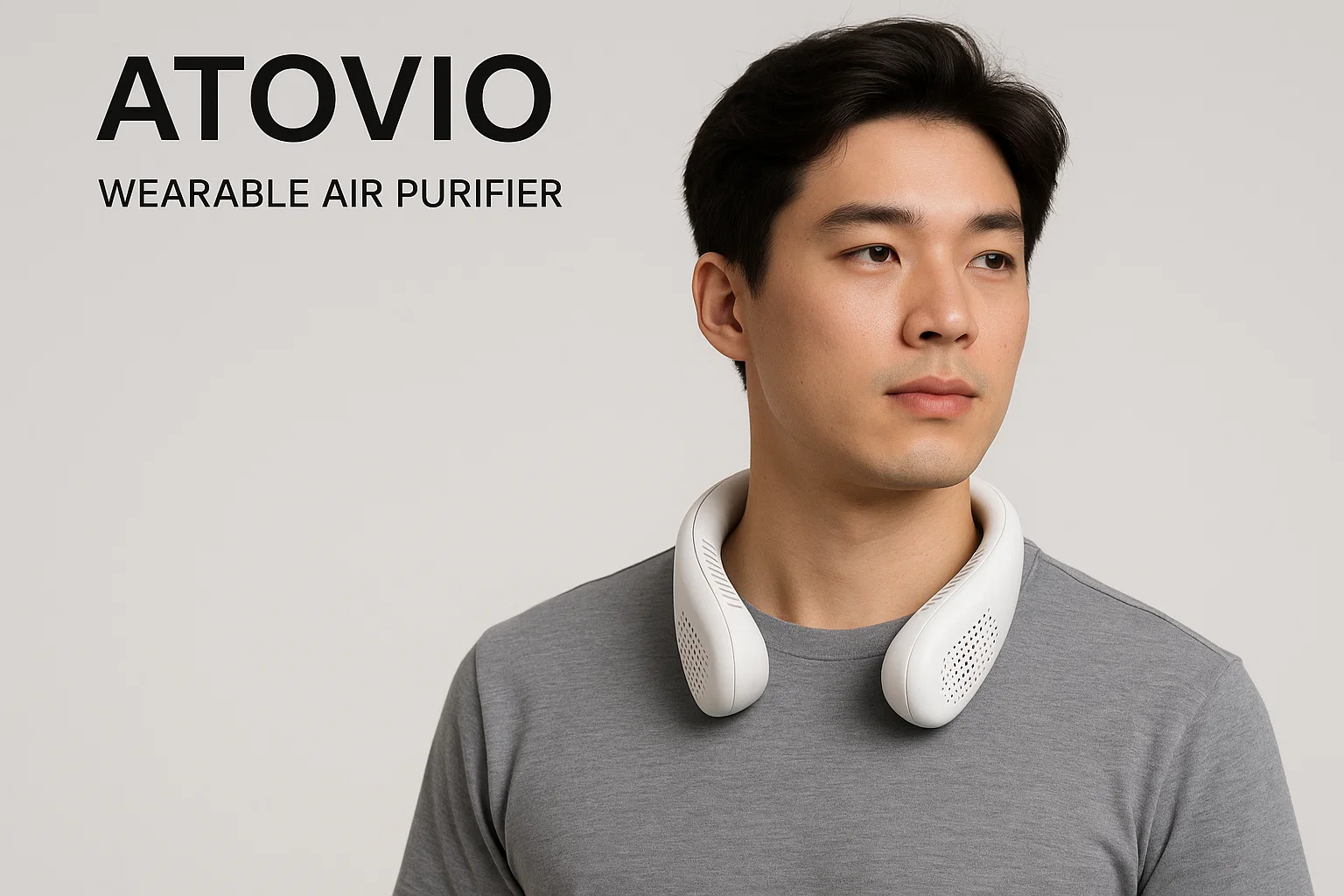
Air pollution is one of the slow, invisible health threats most city dwellers face every day. Masks help, room purifiers help, but what about something that follows you — a small device that creates a bubble of cleaner air around your breathing zone? Enter the Atovio Pebble, a compact wearable air purifier from an Indian consumer-tech startup that promises just that: continuous, hassle-free protection against PM, allergens, smoke and many microscopic pollutants.
In this deep dive we’ll cover how the Pebble works, the tech behind it, real test claims, battery and usability, practical use cases, pros and cons, how it compares to other personal purifiers, and whether it’s a sensible purchase in 2025–26. I’ll also include a concise specs table so you can quickly scan the essentials.
Why a wearable purifier?
Before we jump into the product, let’s set the stage.
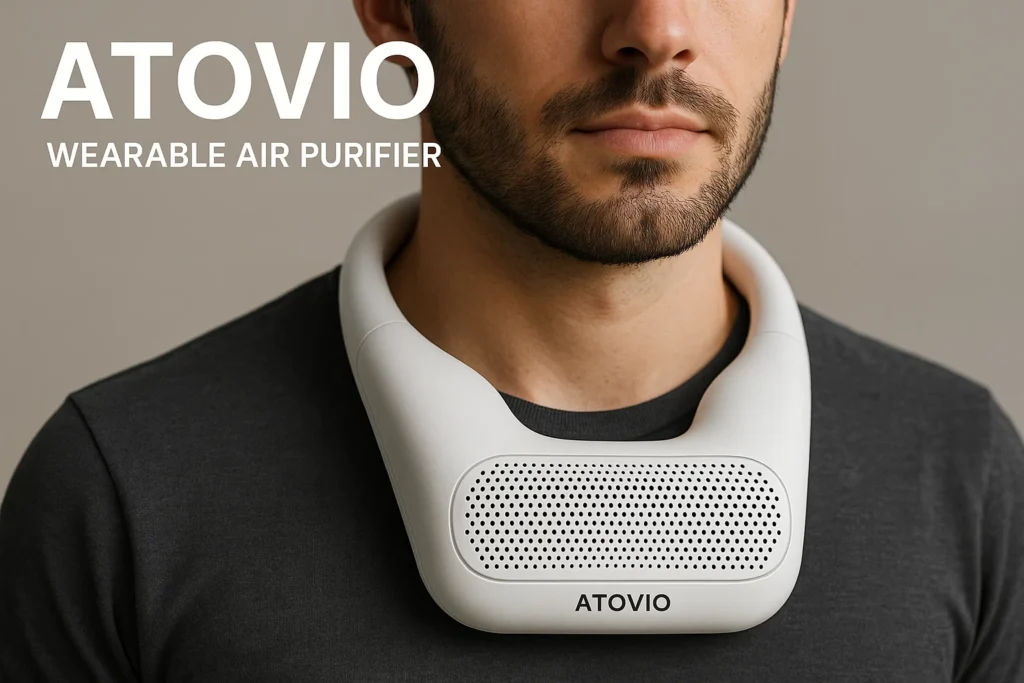
A room air purifier is great at cleaning a larger volume of air, but it doesn’t help when you’re moving — commuting, walking on a polluted street, or sitting in a café. A wearable purifier creates a small, localized zone of cleaner air around your face and upper chest. For many users — people with allergies, parents with small kids, commuters in high-AQI cities — that personal bubble can reduce symptoms and give daily peace of mind.
Atovio’s Pebble is pitched precisely at this problem: lightweight, battery-friendly, and portable enough to clip on clothing or wear on a lanyard.
What is the Atovio Pebble and how does it work?
The Atovio Pebble is a palm-sized wearable purifier that uses Advanced Variable Anion Technology — a method that releases a stream of negatively charged ions (anions) into the air in front of the device. Those anions attach to airborne particles (PM1, PM2.5, PM10), droplets and some biological contaminants, making them heavier and causing them to fall out of the breathing zone or become easier to capture near the device.
Atovio positions the Pebble as a filterless device — meaning there’s no HEPA filter to replace. Instead it relies on ion generation to neutralize and pull particles out of the immediate breathing space. The company also highlights that its engineering keeps ozone generation well below safety limits.
Lab testing & credibility — IIT Kanpur validation
One of the strongest claims Atovio makes is that the Pebble’s performance has been tested at the National Aerosol Facility (NAF) of IIT Kanpur, a respected Indian research facility that studies aerosols and particulate matter. Atovio’s published test reports and certification summaries (hosted on its site) state that the device can reduce up to ~90% of pollutants in a personal breathing space within minutes under controlled test conditions. The company also points to measured safe ozone levels and neutralization of ultrafine particles in those reports.
A quick note: independent validation by a national lab like IIT Kanpur is a positive signal — but as with any lab test, real-world performance depends on many variables (ambient AQI, wind, positioning, and how close the device sits to your face). Still, lab validation is better than marketing claims alone. You can view Atovio’s test report references on their certifications page.
Key specs at a glance (quick table)
Table notes: numbers above are taken from Atovio’s published product pages and test summaries. Performance figures are test-condition claims — real world results can vary.
Real-world use: what the Pebble is good at
- Commuting and travel — subway, bus, crowded taxi or bike rides: having a personal clean-air zone can reduce direct inhalation of pollution or smoke-laden air.
- Indoor spots with poor ventilation — small office corners, cafés, clinics: it helps reduce the immediate particle load around your face.
- Allergy management — pollen and dust exposure reduction for sensitive users; many report fewer sneezes or watery eyes in short term. (User experiences vary.)
- Complementary protection — the Pebble is most useful when combined with other measures: masks in very high AQI, indoor purifiers at home, and avoiding pollution hotspots when possible.
Amazon and other buyer reviews mention the Pebble’s lightweight feel, long battery life and convenience as consistent positives. One verified buyer review noted ease of use and strong battery performance in daily commuting. Amazon India
Pros — what’s appealing about Atovio Pebble
- Portability: genuinely easy to carry, clip or wear. It’s unobtrusive and doesn’t interfere with normal movement.
- Battery life: long runtime (multiple days in light use) makes it low-maintenance.
- No filters to replace: filterless design means lower recurring cost and simpler maintenance.
- Lab tests available: IIT Kanpur NAF test reports increase credibility of the manufacturer’s claims (assuming you review the test conditions).
- Multiple modes: Normal and Turbo let you balance runtime and purification power as needed.
Cons & caveats — where to be cautious
- Filterless ionizers vs HEPA: Ion generators work differently from HEPA filters. HEPA purifiers physically trap particles; ionizers neutralize/aggregate them. In enclosed rooms a HEPA purifier will still be more comprehensive at cleaning room-scale air. A wearable ionizer offers a personal advantage but shouldn’t be seen as a full-room replacement.
- Real-world variability: The “90% reduction in X minutes” figure comes from controlled lab tests; in outdoor windy conditions or when the device sits farther from the face, performance can be lower. Reviewers and users report positive effects, but individual results differ.
- Ozone concerns with ionizers: Some ionization technologies historically generated ozone as a byproduct; Atovio cites safe ozone levels in tests, but users who are ozone-sensitive or who want zero ozone exposure should review the lab data and any third-party validation carefully.
- Not a substitute for masks in all cases: In very high pollution (very high AQI or smoke exposure) an N95 / N99 mask is still a recommended layer of protection — especially in crowded close-contact situations. The Pebble is complementary, not necessarily a full substitute.
How Atovio compares to other personal purifiers
Personal wearable purifiers fall into two broad classes: filter-based neck/pendant purifiers (which pull air using a small fan through a HEPA/charcoal filter) and ionizer/anion devices (which release ions to neutralize particles).
- Filter-based units: pros — physically trap particles, quantifiable filter ratings; cons — require filter replacements, fans can be noisy, and they may be bulkier.
- Ionizer units (Atovio’s approach): pros — lightweight, long battery, filterless maintenance; cons — different mechanism of action, real-world efficacy depends on placement and airflow, and older ionizers sometimes raised ozone worries.
Atovio’s positioning — long runtime, very compact chassis, IIT Kanpur test reports and low claimed ozone — makes it a competitive option for people prioritising convenience and portability. But if you need room-scale purification or guaranteed particle capture irrespective of airflow, a HEPA purifier (room or personal with good CADR) may be preferable.
Practical tips for best results
- Keep it close — wear or clip the Pebble at chest level or hang it on a lanyard so the airflow reaches your face directly.
- Use Turbo in bad AQI — Atovio recommends Turbo when AQI > 200; use White/Normal for everyday moderate pollution.
- Combine layers — for peak protection, use the Pebble along with a well-fitting mask in crowded or very polluted settings.
- Charge regularly — while battery life is excellent, maintain a charging habit so you’re never caught without protection during a commute.
- Verify test reports — if you care deeply about numbers, download and read the NAF/IIT Kanpur report linked on Atovio’s certification page. It shows test conditions and helps set realistic expectations.
Price, availability & warranty
Atovio sells the Pebble directly on its site and through marketplaces. The website lists occasional sale pricing (for example a sale price around ₹3,499 vs a regular price ~₹7,999 at the time of listing), but prices and offers change frequently — always check the current listing and authorised sellers. The brand also advertises a 1-year warranty and a 30-day return/money-back policy on some SKUs.
Verdict — who should buy the Atovio Pebble?
- Recommended for: commuters, allergy sufferers, parents who want extra protection for kids in polluted cities, people who value long battery life and minimal maintenance, and those who prefer a lightweight, wearable solution for day-to-day pollution exposure.
- Not recommended as a sole solution for: people exposed to very high pollution for long periods without masks, or those who need room-scale air purification — in these scenarios, combine devices and layers.
If your daily life involves short bursts of exposure in polluted environments and you want something low-effort that follows you, the Atovio Pebble makes a lot of sense. If you want guaranteed room-level air cleaning, pair it with a proven HEPA room purifier at home or the office.
Final thoughts
Atovio brings an attractive mix of portability, battery endurance, and lab-backed claims to the wearable purifier market. The IIT Kanpur test references and the company’s transparency about ozone figures increase confidence in its approach, while the filterless design reduces ongoing maintenance headaches.
Like most personal-safety tech, the Pebble is best used as part of a layered approach: awareness of AQI, sensible travel choices, a quality mask when required, room purification at home, and a personal wearable for constant protection. If you value convenience and verified lab testing, the Atovio Pebble is worth considering — just read the test report and manage expectations about what a tiny wearable can realistically accomplish in windy outdoor conditions.