

India’s electric vehicle revolution has reached a new milestone. Ola Electric, one of the fastest-growing EV companies in the country, has officially started mass deliveries of its 4680 Bharat Cell-powered electric scooters. This moment is historic not only for Ola, but for the entire Indian EV ecosystem because it marks the beginning of India-made battery cells powering India-made EVs.
For years, India has depended on imported battery cells from China, Korea, and Japan. But with the arrival of the 4680 Bharat Cell — designed, developed, and manufactured in India — Ola Electric has taken the first big step toward battery independence. Now, EVs are set to become more affordable, more reliable, and more powerful.
Let’s dive in.
What Are 4680 Bharat Cells?
The 4680 Bharat Cell is India’s first indigenously developed cylindrical lithium-ion cell, designed by Ola’s Battery Innovation Center (BIC) in Bengaluru. The name 4680 represents its dimensions:
- 46 mm diameter
- 80 mm height
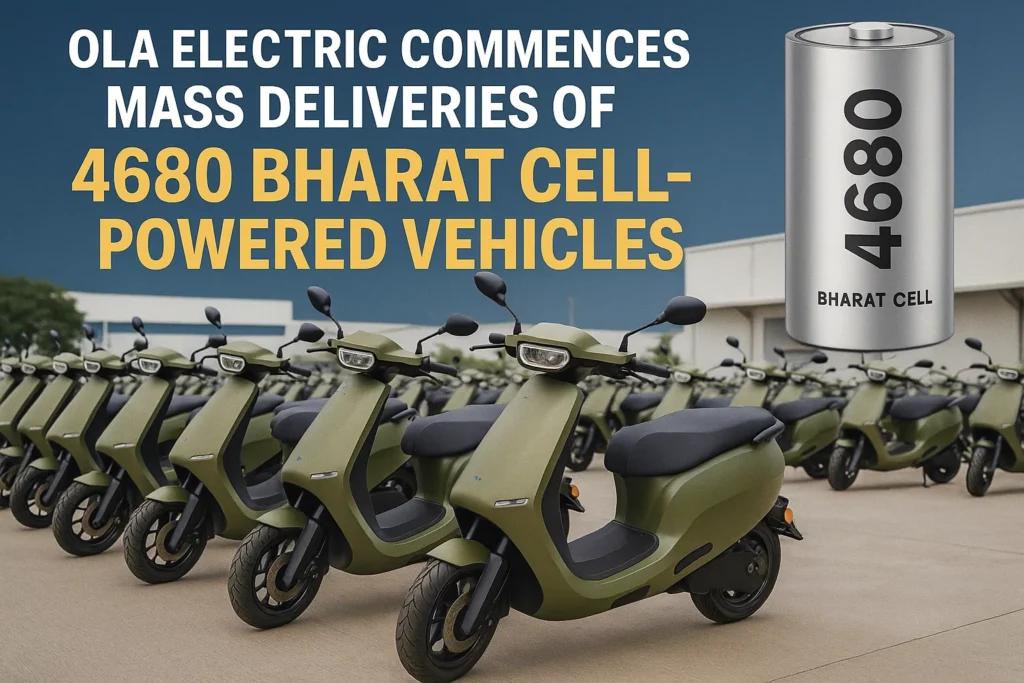
These cells are bigger, stronger, and more efficient than traditional 2170/18650 cells used in most EVs today.
• Larger size = More energy
The bigger physical size helps the cell store a higher amount of energy. This increases the range of the scooter without needing a larger battery pack. More energy in a single cell means fewer cells are required, which reduces complexity and improves performance.
• Faster charging capability
4680 cells are designed to handle higher current flow, giving them the ability to charge faster. This reduces charging time significantly while maintaining battery health. It also ensures the scooter is ready to ride quicker than before.
• Higher power output
These cells deliver more instantaneous power, improving acceleration and ride performance. Riders will notice smoother power delivery and better pickup, especially on inclines. This makes the EV feel more responsive.
• Lower heat generation
Bharat Cells are built for Indian climate conditions, especially high temperatures. Their design ensures they stay cooler even during fast charging or long rides. This increases battery life and overall safety.
Why Ola Delivering 4680 Bharat Cell-Powered Vehicles Is Historic
This is a major turning point for the Indian EV industry.
Here’s why it matters:
• India becomes battery independent
India has been importing 100% of its EV battery cells. With Bharat Cells, Ola becomes the first Indian EV company to use domestically built cells in mass-produced vehicles. This reduces dependency on foreign suppliers and strengthens India’s EV supply chain.
• Lower EV prices in future
Locally produced cells reduce manufacturing costs. Over time, Ola EVs are expected to become more affordable. This makes electric vehicles accessible to more buyers.
• Boost for Make in India
4680 cells are engineered, designed, and manufactured in India. This strengthens the Indian tech ecosystem and promotes job creation in high-tech sectors. It also positions India as a global EV exporter.
• Improved reliability
Indigenous cells are designed specifically for Indian roads, weather, and usage patterns. This ensures better battery health, longer lifespan, and overall reliability for customers.
Ola Electric’s Delivery Push: What It Means for Customers
Ola is delivering thousands of units of its scooters (S1 Pro, S1 Air, S1 X series) equipped with the new 4680 Bharat Cell-based battery packs.
Benefits for customers:
• Higher riding range
The new cells provide improved energy density, giving the scooters a longer riding range per charge. This means fewer charging breaks and longer road trips.
• Faster charging times
Ola promises significantly reduced charging duration with the new cell architecture. This makes daily usage more convenient for users who travel long distances.
• Better performance
With higher discharge capability, riders experience better acceleration, improved torque, and smoother power delivery. The scooter feels more powerful and responsive.
• Improved battery life
Because the new cells generate less heat and are optimized for Indian climate, the battery degrades much slower. Customers get long-lasting performance without frequent replacements.
Features of Ola’s New 4680 Cell-Powered Battery Pack
Below are the main features along with simplified 3–4 line explanations:
1. Higher Energy Density
The new battery pack can store more energy in the same space, giving scooters longer range. This means Ola scooters now go farther on a single charge. Riders save time and enjoy more freedom.
2. Fast-Charging Capability
4680 cells support high-speed charging effortlessly. Ola’s future Hypercharger network will deliver charge much faster than before. This is ideal for long rides and emergency top-ups.
3. Improved Thermal Management
Heat is one of the biggest threats to battery life. The new cells stay cooler during fast charging and long rides. This improves battery health and maintains consistent performance.
4. Increased Structural Strength
The larger cylindrical cell design provides more strength and durability. This reduces the chances of internal damage due to vibrations or impacts. Perfect for Indian road conditions.
5. Higher Peak Power Output
Scooters powered by the new cells deliver superior acceleration and power. You get faster pickup and smooth performance even on steep inclines. Everyday commuting becomes more enjoyable.
Performance Improvements in Real-World Riding
Customers who receive the new scooters will notice:
• Smoother Acceleration
Power delivery feels more linear and responsive. The scooter reacts instantly to throttle input, improving city ride comfort.
• Better Hill Climbing Performance
Indian roads often include steep slopes and flyovers. The new cells provide better torque, making the scooter climb effortlessly.
• Reduced Heat During Long Rides
Long-distance riders will appreciate lower battery temperatures. Cooler battery = longer life + more safety.
• Higher Consistent Range
Unlike older cells that lose efficiency over time, Bharat Cells maintain output for a longer period. Even after months of usage, range stays more reliable.
Impact on India’s EV Ecosystem
Ola’s Bharat Cells are not just a technological upgrade — they are a shift in India’s electric future.
1. Strengthening India’s EV Supply Chain
Local battery manufacturing reduces imports, cuts cost, and promotes energy independence.
2. Boost for Local Manufacturing
The move encourages more companies to invest in battery R&D within India. This builds confidence in India’s manufacturing capabilities.
3. Price Stability for EVs
With reduced dependence on global markets, battery prices — the most expensive EV component — will stabilize. This will bring overall EV prices down.
4. Job Creation in High-Tech Sectors
Battery manufacturing, R&D, cell testing, and assembly generate thousands of skilled jobs. This contributes to India’s growing tech workforce.
5. India Becomes a Global EV Export Hub
Indigenous cell production positions India to export EVs and battery tech to other countries in the future.
Future Roadmap: What Ola Plans Next
Ola Electric has big goals ahead:
• Full-scale cell manufacturing
Ola is building one of the world’s largest Gigafactories in Tamil Nadu. It aims to produce millions of cells every year.
• Expansion of Hypercharger Network
The company plans nationwide fast-charging infrastructure with its upgraded cell technology.
• New EV Models
Ola is working on e-motorcycles and e-cars powered by Bharat Cells. These will be launched in upcoming years.
• Exporting Bharat Cell Tech
Future plans include exporting battery cells to global EV manufacturers — making India a battery tech leader.
Conclusion: A Giant Leap for India’s EV Future
With the mass delivery of 4680 Bharat Cell-powered vehicles, Ola Electric has not just delivered scooters — it has delivered a new future. A future where:
- India builds its own batteries
- EVs become more affordable
- Charging becomes faster
- Range gets longer
- Performance becomes stronger
This is more than a technology upgrade — it is a movement toward India’s self-reliance in clean mobility. Ola Electric has opened the doors to an EV revolution powered by Indian innovation.
The journey has just begun, and the future looks electric.