
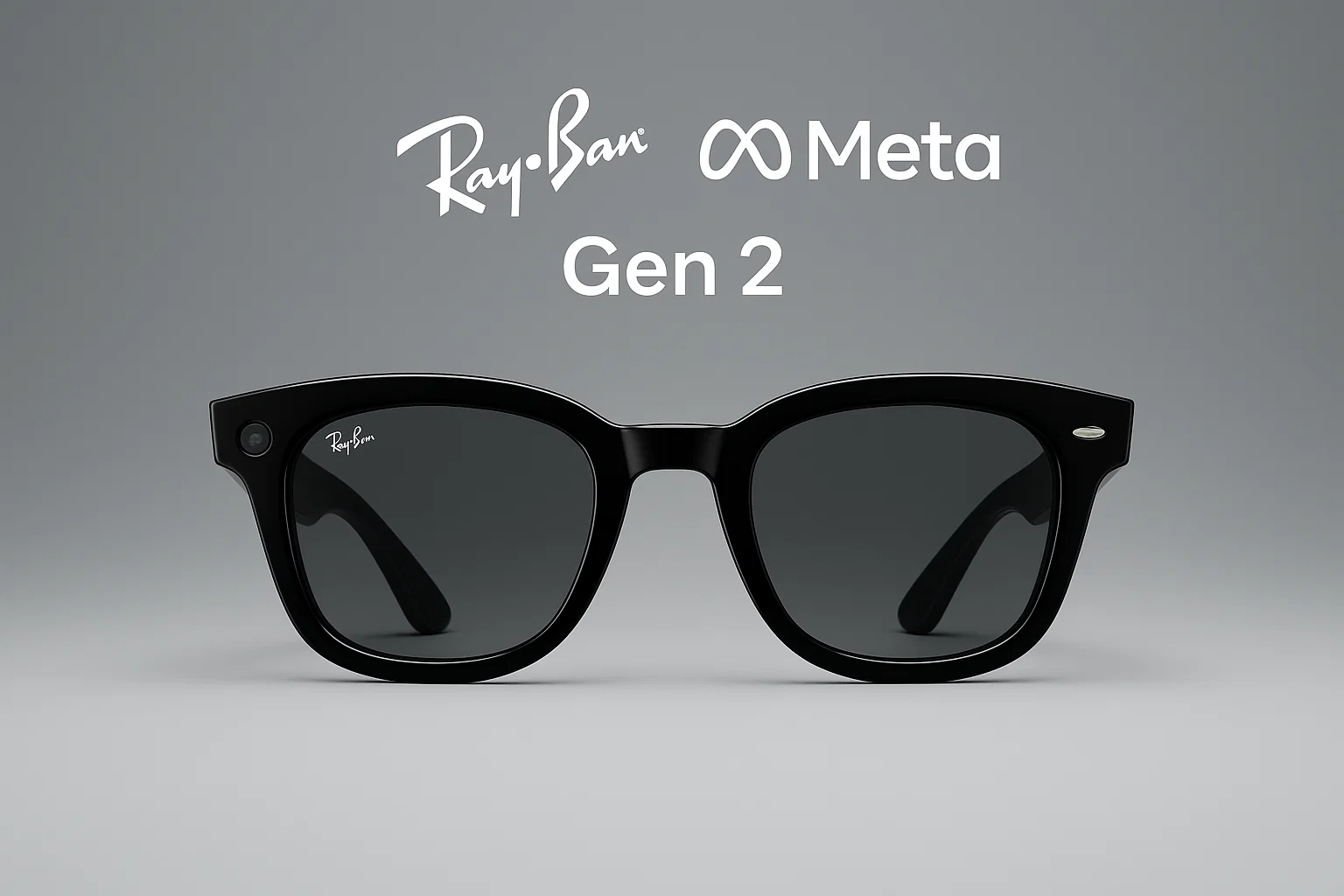
Smart glasses have been promised for a decade. The Ray-Ban Meta Gen 2 tries to make that promise practical: it keeps the iconic Ray-Ban silhouettes, adds stronger cameras and microphones, longer battery life, and a more conversational Meta AI on your face. The result is not a perfect future — but it’s a compelling and surprisingly usable step toward everyday wearable computing. Below I walk through what the Gen 2 glasses are, how they actually perform, the key specs in a quick table, what they’re good (and not good) for, and whether they make sense for you.

Quick TL;DR
- Ray-Ban Meta Gen 2 are sunglasses/eyeglass frames with built-in cameras, microphones, speakers and Meta AI integration — designed for discreet capture, hands-free voice assistance, and media playback.
- Key hardware upgrades over Gen 1: improved video capture (marketed as 3K Ultra HD), substantially longer battery life (up to ~8 hours on a charge in some modes), and deeper Meta AI (LLAMA-4 power).
- In India the Gen 2 launched with prices starting around ₹39,900 and new India-specific features such as Hindi Meta AI support and UPI payment integrations.
- Practical verdict: excellent for quick point-of-view photos and voice-first assistance, good battery life for a wearable, but privacy and social comfort remain major considerations.
What is new in Gen 2 (at a glance)
Meta and Ray-Ban positioned Gen 2 as the “next step” — not a radical redesign but a careful set of improvements where it matters for daily use:
- Camera & media: Gen 2 is promoted with upgraded video capture (3K Ultra HD), intended to produce noticeably sharper handheld/POV video than Gen 1.
- Battery life: Meta and Ray-Ban say Gen 2 can deliver up to roughly twice the battery life of Gen 1 — around 8 hours in certain use profiles — which moves the glasses from short bursts to all-day casual use.
- AI experience: Gen 2 integrates newer LLAMA-4 based Meta AI, allowing a hands-free “Hey Meta” conversational assistant, faster contextual queries and on-device assisted workflows.
- Design & comfort: Subtle profile changes and new colorways aim to make the tech less obvious and the frames more wearable for long periods.
Quick specs table
Real-world experience: what works well
1. Capture on the fly
The Gen 2 is built to remove friction: tap, voice, or app commands let you capture photos and POV video without pulling out your phone. For travel, events, or quick “show me” captures, that immediacy is valuable. The upgraded video is visibly cleaner than first-gen captures when lighting is decent.
2. Much better battery
Battery life was the single biggest complaint about many early wearables. Doubling runtime means you can realistically wear them for long periods and rely on them for daytime activities without constant recharging — a big step toward practical daily wearables. That said, heavy video recording or long phone calls will still drain the battery faster.
3. Voice first, not intrusive
Meta AI (LLAMA-4) gives the glasses solid conversational capability — quick answers, translations, and contextually aware help without unlocking your phone. That voice experience is what differentiates Gen 2 from ordinary audio sunglasses. Ray-Ban Official Store India
4. Familiar fashion
Because the frames are classic Ray-Ban shapes, they feel more like clothing than a conspicuous gadget. For many users that lowers the social barrier to wearing them in public.
Limitations and real concerns
1. Privacy & social friction
Wearing a camera on your face remains socially sensitive. People may feel recorded; establishments may restrict use; and conversations about informed consent don’t disappear just because the device looks like sunglasses. Many reviewers highlight that being a camera “on the face” continues to raise questions and awkwardness. This is not a flaw in hardware — it’s a social design problem that tech cannot solve yet.
2. Image quality limits
The new “3K” marketing is a meaningful step up, but glasses cameras still have physical constraints (tiny lenses, limited stabilization). Expect great quick clips and sharp daylight photos — but don’t expect smartphone flagship cinematic footage. For pro content, your phone or a dedicated camera remains superior.
3. Feature tradeoffs
All-day battery claims are usage dependent. Enabling always-on AI, frequent video capture, or loud audio will shorten runtime materially. Similarly, features that require cloud access (some Meta AI capabilities, live-streaming) still rely on your phone’s connection.
4. Price vs alternatives
The Gen 2 sits in a premium niche: it’s not cheap. If your needs are simple (music + calls), many earbuds offer better audio and price; for creative video/photo work, phones and action cameras still deliver more control. The glasses’ value is in the combination: hands-free capture + persistent voice AI + Ray-Ban styling.
Who should buy Ray-Ban Meta Gen 2?
Good fit if you:
- Want hands-free capture and quick POV content for social sharing.
- Value the convenience of a voice assistant without using your phone.
- Prefer iconic eyewear styles and want prescription/sunglass options.
- Live in a place where privacy rules and social norms are understood and you’re comfortable wearing a camera.
Not a great fit if you:
- Need pro camera features (manual controls, stabilization for long takes).
- Are highly privacy-conscious about being recorded in public or in workplaces where cameras are restricted.
- Prefer the absolute best audio (earbuds still outperform on fidelity and isolation).
Practical buying tips
- Try them on in a store if possible. Comfort, weight distribution, and how discreet the camera looks vary by frame and face shape.
- Check local features — localized AI language support (for example Hindi in India) and payment integrations (UPI) were announced for specific markets, so check what’s active for your region.
- Compare Gen 1 prices: with Gen 2 out, Gen 1 discounts can be compelling if you don’t need the extra battery or video enhancements.
- Mind the app: features, sharing, and firmware updates depend on the companion app and Meta’s software roadmap. Keep the app updated and read permissions carefully.
Privacy, etiquette and legal notes
Smart glasses force us to think about social norms and legal frameworks. When using Gen 2:
- Be explicit if you’re recording people; many places require consent for filming.
- Respect venue rules; museums, concert halls, and some restaurants ban cameras.
- Familiarize yourself with local laws about audio recording — one-party consent vs two-party laws vary by jurisdiction. (This is general guidance; consult local legal resources for specifics.)
The future: why Gen 2 matters
Gen 2 doesn’t “solve” all smart-glass problems, but it makes the device significantly more usable day-to-day. Better battery life, improved video capture, and a more conversational AI mean the glasses are less of a novelty and more of a genuinely useful accessory. For the industry, that’s the essential step: move from tech demo to utility. If Meta and Ray-Ban continue to iterate on privacy features, on-device AI, and opt-in transparency, the concept could become mainstream — albeit gradually and with important social conversation along the way.
Final verdict (short)
Ray-Ban Meta Gen 2 is the most polished iteration yet of mainstream smart glasses: stylish, more capable, and more practical. If you value hands-free content capture and an always-available voice assistant and are comfortable with the privacy and social implications, Gen 2 is a meaningful buy. If your priorities are pro photography, top-tier audio, or guaranteed anonymity in public spaces, stick to dedicated cameras or earbuds.